
Srimanta Sankaradev Kalakshetra, commonly known as Kalakshetra, is a cultural institution in the Panjabari area of Guwahati, Assam, India, named after the medieval poet-playwright and reformer Srimanta Sankardev.
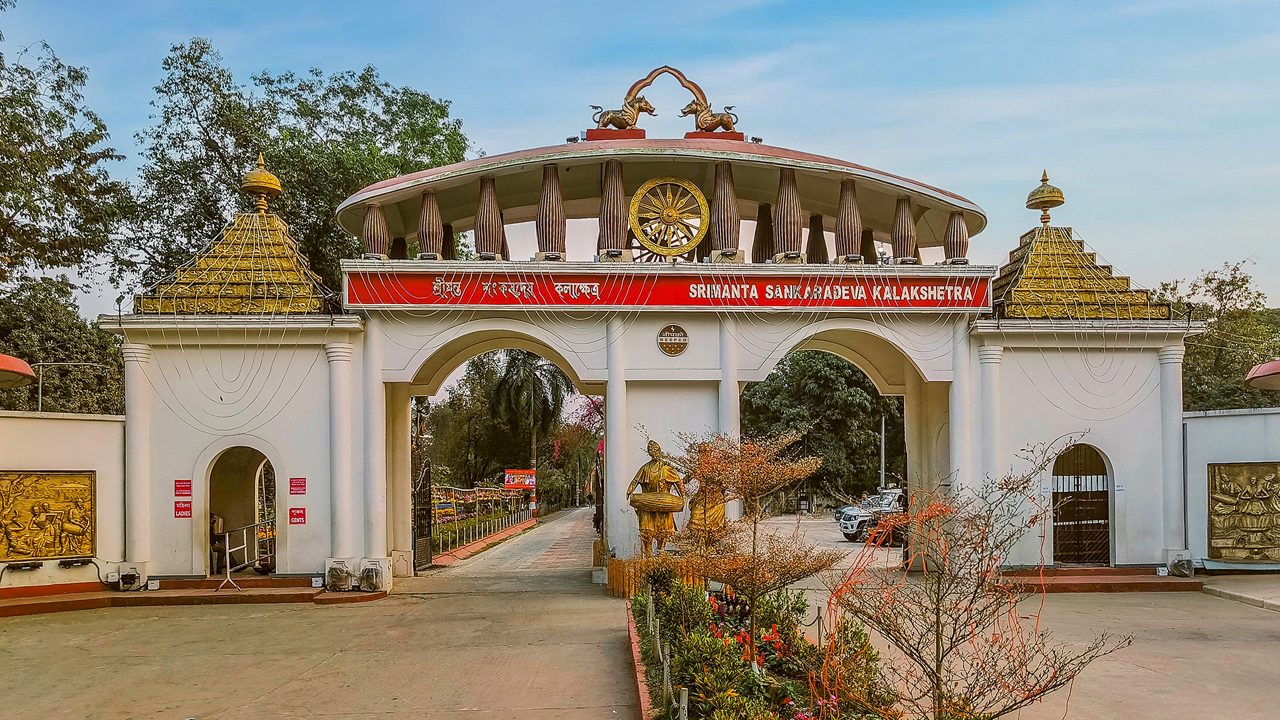
Srimanta Sankaradeva Kalakshetra is Assam’s premier cultural complex in Panjabari, Guwahati, dedicated to preserving and showcasing the state’s diverse heritage. Its foundation was laid in 1988 and it was formally dedicated to the nation in 1998.
Overview and significance
Named for the 15th‑century saint‑scholar Srimanta Sankaradeva, the institution promotes unity in diversity and preserves the cultural heritage of Assam’s many communities.
Operated by the Srimanta Sankaradeva Kalakshetra Society with General, Executive, and Academic councils.
Spread over about 17.5 hectares at Panjabari, Guwahati.
Phase I construction was fully funded by India’s Ministry of Human Resource Development at a cost of ₹20.15 crore.
Phase II added the International Convention Centre; three auditoria were planned, with two completed seating 300 and 1,250 respectively.
History and key dates
Conceived by the Government of Assam’s Cultural Advisory Committee on 5 August 1986.
Foundation laid on 2 February 1988 by then Governor Bhisma Narayan Singh.
In 1990, the state sought to place the project under Clause VI of the Assam Accord to safeguard Assamese identity and heritage.
On 9 November 1998, President K. R. Narayanan bestowed the Kalakshetra to the nation.
Note: Some travel sites mention a “built in 1990” date, but official records show a 1988 foundation and 1998 dedication; the official timeline is more authoritative.
What to see and do
Museum and Cultural Centre: Assamese artifacts, traditional clothing, musical instruments, and historical relics.
Open‑air theatre: Regular cultural performances in music, dance, and theatre.
Artists’ Village: Recreation of rural Assamese life, architecture, and crafts.
Perimeter wall murals: Vivid depictions of Assamese culture and history.
Light & Sound Show: Typically in the evening; confirm operational status before visiting.
Auditoria (Convention Centre): Two completed halls with capacities of 300 and 1,250; a third was planned.
Practical information for visitors
Location: Panjabari, Guwahati.
Best time: Late afternoon/early evening to avoid heat and, if running, catch the light & sound show.
Facilities: Restrooms, a cafeteria, and parking available on site.
On‑ground notes: Some areas may need maintenance; mosquitoes can be prevalent in the evening—carry repellent.
Tickets and timings: Entry is reasonably priced; confirm current hours and light‑and‑sound schedule before visiting.
Recommendation: Plan roughly 1.5–2.5 hours for the museum, murals, and Artists’ Village; more if attending a performance (planning estimate).